- January 4, 2026
Ringspun vs Carded Cotton: What’s the Difference?
When selecting fabric for custom t-shirts, the type of cotton used often determines the difference between a basic garment and a premium one that stands out. Two common options dominate the market: ringspun cotton and carded cotton. These terms refer to distinct manufacturing processes that affect everything from softness and durability to how well the fabric accepts custom prints.
Many buyers assume all 100% cotton t-shirts feel and perform similarly. In reality, ringspun vs carded cotton reveals significant variations in quality, comfort, and suitability for printing. Understanding these differences helps ensure your custom apparel meets expectations—whether for branding, events, teams, resale, or long-term custom t-shirt printing projects that require consistent quality and comfort.
At Custom Tees Now, we offer a range of cotton fabrics to match diverse project needs. This in-depth guide explains the key distinctions between ringspun cotton t-shirts and carded cotton shirts, explores cotton types for printing, and provides clear recommendations to help you choose wisely.
How Cotton Becomes Yarn: The Manufacturing Basics
Cotton starts as raw fibers harvested from the plant. These fibers vary in length, with longer staples generally producing higher-quality yarn. The transformation into fabric involves cleaning, aligning, and spinning the fibers into yarn, a process known as the cotton yarn spinning process, which directly affects softness, strength, and consistency.
The primary divergence occurs during yarn production:
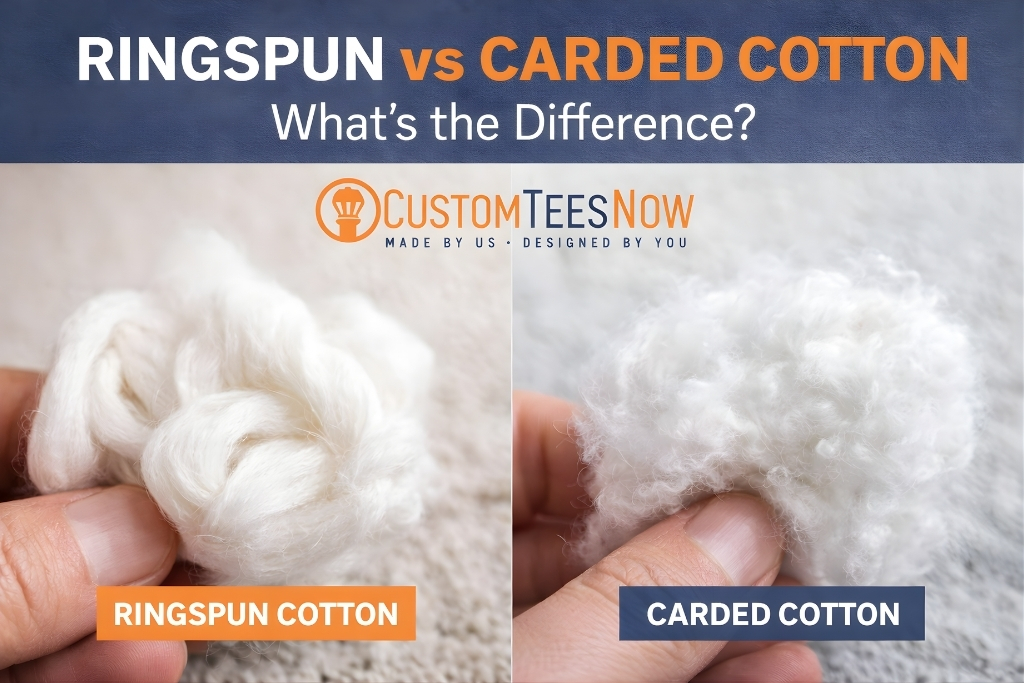
- Carded cotton (also called carded open-end or regular cotton) undergoes basic processing. Fibers are cleaned and roughly aligned through carding, then spun using an open-end method where fibers are twisted together quickly and economically.
- Ringspun cotton builds on carding (and often includes extra combing) but uses a more precise ring-spinning technique. Fibers are continuously twisted and thinned on a ring frame, aligning them uniformly in the same direction for a tighter, smoother yarn.
This fundamental process difference creates fabrics with noticeably different characteristics.
Key Differences Between Ringspun and Carded Cotton
The spinning method impacts texture, strength, appearance, and performance. Here is a side-by-side comparison:
| Aspect | Ringspun Cotton | Carded Cotton (Open-End) | Winner for Most Custom Projects |
| Yarn Structure | Fibers twisted tightly and aligned uniformly | Fibers loosely bundled, more random orientation | Ringspun |
| Feel/Softness | Exceptionally soft, smooth, luxurious from day one | Coarser initially, may soften slightly over time | Ringspun |
| Durability | Stronger, resists pilling, fraying, and wear better | Prone to pilling, thinning, and faster breakdown | Ringspun |
| Surface Quality | Smooth, even surface with fewer loose fibers | Fuzzy, uneven with more impurities and stray fibers | Ringspun |
| Printability | Crisp, vibrant prints; holds detail and ink well | Ink may absorb unevenly; fibers show through prints | Ringspun |
| Opacity & Drape | Better opacity, consistent drape | May be more sheer in lighter weights; looser drape | Ringspun |
| Cost | Higher due to labor-intensive process | More affordable and economical | Carded for budget priorities |
| Best For | Premium branding, retail, frequent wear, detailed designs | Bulk promotions, one-time events, basic needs | Depends on goals |
Ringspun cotton consistently outperforms in quality metrics, while carded cotton excels in cost efficiency for high-volume, short-term use.
Advantages of Ringspun Cotton T-Shirts
Ringspun cotton t-shirts deliver noticeable benefits that justify the investment for many applications:
- Superior softness creates immediate comfort, encouraging longer wear and higher perceived value.
- Enhanced durability means the garment maintains shape, color, and softness through repeated washes.
- Reduced pilling keeps the surface looking clean and professional over time.
- Tighter weave improves breathability without sacrificing structure, making it suitable for various climates.
- Premium hand-feel elevates brand perception—ideal for merchandise, corporate apparel, or fashion-forward designs.
These qualities make ringspun a go-to for projects where customer satisfaction and longevity matter.
Advantages of Carded Cotton Shirts
Carded cotton shirts remain popular for valid reasons:
- Lower production costs allow for larger orders without exceeding budgets.
- Suitable for promotional giveaways, events, or uniforms where items see limited use.
- Often heavier and more substantial in feel, providing a classic, sturdy option for workwear or casual basics.
- Adequate for simple, large-scale prints where intricate detail is not required.
- Easier availability in high quantities from many suppliers.
For cost-sensitive projects with basic requirements, carded cotton delivers reliable performance without unnecessary expense.
Why Printing Method Matters in Cotton Choice
Cotton types for printing play a crucial role in final results. The fabric surface directly influences ink adhesion, color vibrancy, detail retention, and wash durability. Understanding the differences between DTG vs. Screen Printing helps determine which cotton type delivers better color accuracy, durability, and long-term wear performance.
- Screen Printing: Ringspun cotton provides the ideal canvas for professional screen printing services, allowing ink to sit cleanly on the surface for sharper edges, richer colors, and longer-lasting results. Its smooth, consistent surface allows ink to lay flat, producing sharp edges, rich colors, and minimal show-through of fibers. Multi-color or detailed designs hold up exceptionally well. Carded cotton can result in textured prints where loose fibers poke through, leading to a less polished appearance and potential cracking over time.
- Direct-to-Garment (DTG) Printing: Ringspun (especially combed ringspun) excels here too. The even texture captures fine gradients and intricate artwork without bleeding. Carded options may absorb ink unevenly, reducing sharpness.
- Embroidery: Both work, but ringspun offers a denser base that prevents puckering around stitches. Carded cotton handles basic logos adequately.
For professional, long-lasting custom prints, ringspun cotton consistently yields superior outcomes.
When to Choose Ringspun vs Carded Cotton
Tailor your selection to project specifics:
- Opt for ringspun cotton when:
- Building a brand or selling merchandise—premium feel boosts perceived value.
- Creating detailed or full-color designs that demand crisp results.
- Prioritizing comfort and durability for repeated wear.
- Targeting retail, events, teams, or corporate clients who value quality.
- Choose carded cotton when:
- Budget is the primary constraint and volume is high.
- Items are for one-time promotions, giveaways, or short-term use.
- Designs are simple (e.g., single-color text or basic logos).
- The focus is on quantity over long-term performance.
Many successful orders blend both: ringspun for core products and carded for supplementary bulk runs.
Additional Factors to Weigh
Beyond the core differences, consider these elements:
- Weight and Blend: Ringspun often pairs with lighter GSM for a premium, airy feel; carded frequently appears in heavier basics. Blends (e.g., cotton-poly) can alter characteristics—ringspun blends retain more softness.
- Shrinkage and Care: Both shrink somewhat, but ringspun typically holds shape better with proper washing (cold water, air dry recommended).
- Sustainability: Ringspun processes may use longer-staple fibers efficiently, though both can incorporate responsibly sourced cotton.
- Testing: Always request samples. Feel the hand, test prints, and wash a garment to simulate real use.
Tips for Ordering Custom T-Shirts with Confidence
To achieve the best outcome:
- Define priorities—comfort, print quality, budget, or volume—early in planning.
- Discuss fabric options with your provider to match the right cotton to your design and use case.
- Request free proofs to verify how the print appears on chosen material.
- Factor in care instructions to maintain fabric and print integrity.
- Start small if unsure—test a few weights or types before scaling up.
At Custom Tees Now, our team guides clients through these choices daily. We stock quality ringspun options alongside economical carded fabrics, ensuring flexibility for every project.
Conclusion: Making the Right Choice for Your Custom Apparel
The debate of ringspun vs carded cotton boils down to priorities. Ringspun cotton delivers unmatched softness, durability, and print excellence, making it the preferred choice for premium custom t-shirts that impress and endure. Carded cotton offers practical, budget-friendly performance for high-volume or temporary needs.
By understanding these distinctions, you position your custom apparel for success—enhancing comfort, elevating designs, and satisfying recipients. Whether pursuing top-tier ringspun cotton t-shirts for branding or reliable carded cotton shirts for promotions, the right cotton transforms ordinary garments into effective tools.
Ready to select the perfect fabric for your next order? Contact Custom Tees Now today for expert advice, free design help, and competitive quotes. Our experience ensures your vision becomes reality with the ideal cotton types for printing. Let’s create apparel that stands out—reach out now.