- April 1, 2026
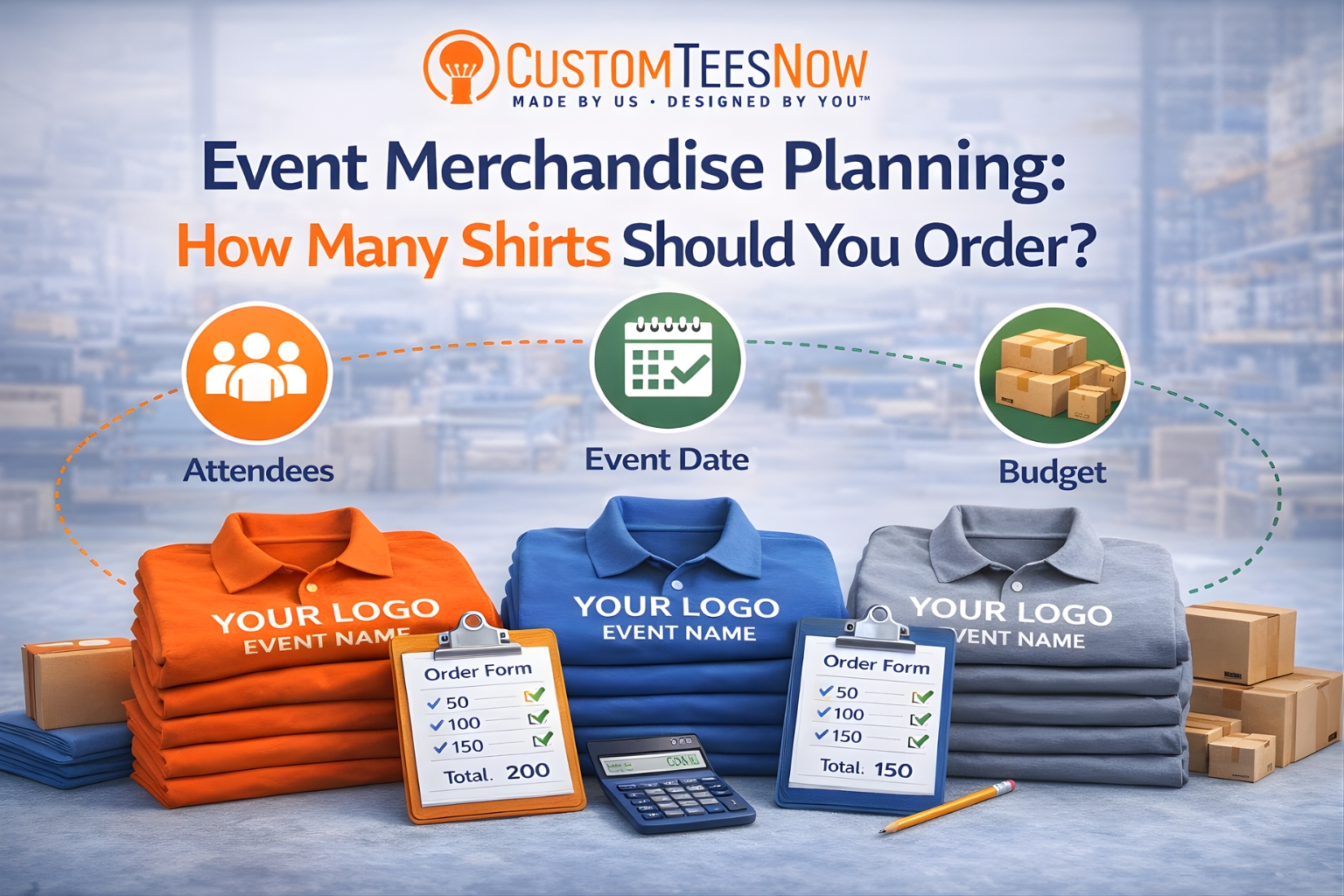
Event Merchandise Planning: How Many Shirts Should You Order?
Planning an unforgettable event requires attention to every detail, from venue selection to guest experience. Yet one critical element often leads to last-minute stress or costly regrets: deciding exactly how many custom shirts to produce. Whether you’re organizing a corporate conference, music festival, charity run, or community fundraiser, smart event merchandise planning transforms branded apparel from a simple giveaway into a powerful tool for engagement, promotion, and lasting brand recall. Get the quantity wrong, and you risk empty racks on day one or boxes of unsold inventory gathering dust afterward. Get it right, and your shirts become walking billboards that attendees proudly wear long after the event ends.
At its core, effective event merchandise planning balances expected attendance, audience demographics, budget constraints, and production realities. It accounts for real-world variables like participation rates, sizing preferences, and even post-event wearability. In today’s competitive landscape, where events compete for attention across digital and in-person channels, well-planned merch can boost attendee satisfaction while delivering measurable marketing value.
This comprehensive guide walks through every aspect of determining the ideal order size. You’ll discover data-driven formulas, sizing strategies, budget considerations, and practical examples tailored to different event formats. By the end, you’ll have a clear framework to make confident decisions that protect your budget and maximize impact.
Why Strategic Event Merchandise Planning Matters More Than Ever
Events have rebounded strongly, with many organizers reporting an increase in in-person attendance. At the same time, budget pressures remain real—planners are shifting away from wasteful swag bags toward more intentional, high-value items.
This environment makes precise planning essential. Over-ordering ties up capital in unsold stock and creates storage headaches. Under-ordering disappoints eager participants and misses opportunities to organically promote your designs when guests share photos of themselves wearing them on social media. Successful planners treat shirts as an investment rather than an expense, using them to reinforce themes, foster community, and extend brand visibility beyond the event dates.
Consider a typical corporate retreat with 300 expected attendees. If 70% of participants receive or purchase a shirt, that’s roughly 210 pieces in circulation—each one potentially reaching colleagues, family members, or future clients. For a music festival drawing 5,000 fans, even a modest 10-15% conversion rate on sales merchandise could mean hundreds of additional impressions. The key lies in moving beyond guesswork to a systematic approach grounded in data and experience.
Assessing Your Event’s Scale and Audience Demographics
Every event is unique, so the first step is to gather specific intelligence about your crowd. Start by reviewing historical data from similar past gatherings. Did registration numbers match the actual turnout? What percentage of attendees engaged with merchandise? Factors such as age range, gender balance, geographic location, and event purpose all influence demand.
Corporate conferences and trade shows often feature more conservative professionals who appreciate polished, versatile designs suitable for office wear afterward. Music festivals and outdoor celebrations attract younger, trend-conscious crowds who favour bold graphics and comfortable, durable fits. Sports tournaments or charity runs might prioritize performance fabrics and motivational messaging. Family reunions or school events require inclusive sizing that accommodates children through seniors.
Audience size provides the foundation for calculations. Reliable registration platforms or ticket sales data give you a starting point, but always factor in no-shows, last-minute additions, and staff or VIP needs. Weather, competing events, and economic conditions can also shift final headcounts. Planners who track these variables year over year develop increasingly accurate forecasts that minimize waste.
Location plays a subtle but important role, too. Events in tourist-heavy destinations often see higher walk-up traffic, while tightly controlled corporate venues allow for more precise headcounts. Understanding these nuances helps refine your projections and ensures shirts align with the overall atmosphere.
Determining the Right Numbers: A Data-Driven Approach
Accurate forecasting prevents both shortages and excess inventory. The most reliable method begins with a simple formula: multiply expected attendance by your estimated participation rate, then add extras for staff, volunteers, and a safety buffer. Participation rates typically range from 60% to 85% for complimentary giveaways at corporate or charity events, while sales-oriented merchandise at festivals might convert at 5% to 15% of total attendees, depending on design appeal and pricing.
For instance, a 500-person industry conference might target 350 shirts if planners expect a 70% uptake rate. A weekend festival anticipating 2,000 visitors could aim for 150 to 300 pieces if focusing on paid sales. Always build with a 10% to 15% buffer to handle unexpected demand spikes or on-site sizing swaps.
Accurately forecasting your event shirt quantity prevents both shortages and excess inventory while ensuring every attendee has the chance to take home a memorable piece.
The table below provides practical benchmarks for common event formats. These figures serve as conservative starting points that experienced organizers adjust based on their specific data.
| Corporate Conference | 200–500 | 150–400 shirts | 70–80% | 10–15% |
| Music Festival | 1,000–5,000 | 100–750 shirts | 5–15% (sales) | 15–20% |
| Charity Run/Walk | 300–1,000 | 250–800 shirts | 75–85% | 10% |
| Trade Show Booth | 500–2,000 daily | 200–600 shirts | 40–60% | 15% |
| Family Reunion/School Event | 100–300 | 80–250 shirts | 80–90% | 5–10% |
These ranges account for typical engagement patterns while leaving room for customization. Notice that larger festivals require proportionally fewer shirts per total crowd size because not everyone purchases merchandise.
Perfecting Size Distribution for Maximum Fit and Satisfaction
Once you’ve settled on the total quantity, the next challenge is breaking it down by size. Poor distribution leads to disappointed customers and leftover stock in unpopular sizes. Industry patterns remain remarkably consistent: medium and large sizes dominate demand, followed by small and extra-large, with plus sizes making up a smaller but essential portion.
A proven starting ratio for adult unisex apparel is approximately 1:2:2:1 for small, medium, large, and extra-large. For every 100 shirts, that translates to roughly 15 small, 30 medium, 30 large, and 20 extra-large, with the remaining 5–10 pieces allocated to 2XL and 3XL based on your audience profile.
The following table provides a scalable breakdown for a 300-shirt order—the sweet spot for many mid-sized events.
| Small | 15% | 45 | Adjust upward for younger crowds |
| Medium | 28% | 84 | Often the most requested size |
| Large | 32% | 96 | Highest demand category |
| XL | 18% | 54 | Critical to avoid shortages |
| 2XL | 5% | 15 | Growing need in many demographics |
| 3XL+ | 2% | 6 | Include at least a few for inclusivity |
Always round up fractions to ensure availability. If your event skews heavily toward athletes or includes children’s sizes, incorporate them separately. Offering on-site swaps or pre-event size collection forms can further reduce mismatches.
Budget Considerations and Smart Cost Management
Quantity decisions directly affect unit pricing. Smaller runs carry higher per-piece costs due to setup fees, while larger volumes unlock significant savings through economies of scale. When ordering event apparel, smart planners evaluate not just sticker price but total value—including design revisions, shipping, taxes, and potential rush fees. Bulk orders often qualify for volume discounts that can reduce costs by 30% or more compared to small batches.
Factor in the marketing ROI: each shirt worn repeatedly serves as free advertising, potentially justifying a slightly larger initial investment.
Production Timelines and Quality Assurance
Timing plays a pivotal role in successful execution. Standard production windows range from 7 to 14 business days after artwork approval, though rush options exist for urgent needs. Build in extra cushion for design proofs, revisions, and shipping—especially if your event falls during peak seasons.
High-quality materials and printing techniques ensure shirts withstand multiple washes without fading, increasing the likelihood that attendees will continue to display your brand. For more details on turnaround times and policies, explore our comprehensive FAQ page.
If you’re looking for proven design ideas that drive engagement, check out our guide on designing shirts people actually want to wear.
Common Pitfalls and How to Avoid Them
Even seasoned planners encounter challenges. One frequent mistake involves relying solely on maximum possible attendance rather than realistic turnout data. Another is neglecting demographic shifts—ordering the same size mix year after year without updating for changing audience profiles. Overly ambitious designs that require complex multicolour prints can inflate costs and unnecessarily extend timelines.
By applying these merchandise planning tips early in your process, you can sidestep these issues and create a seamless experience from concept to delivery. Incorporate feedback loops after each event to refine future forecasts, turning one-time planning into an evolving strength.
Leveraging Merch for Long-Term Brand Impact
Beyond the event itself, thoughtfully chosen shirts extend your reach. Attendees who wear them to the gym, office, or next gathering become brand ambassadors. Sustainable fabric choices and timeless designs encourage repeated wear, amplifying return on investment.
Some organizers create tiered merchandise programs—premium options for VIPs, standard shirts for general attendees, and limited-edition variants for early registrants. This strategy manages inventory while heightening perceived value.
Ready to Execute Your Perfect Order?
Event merchandise planning succeeds when data, creativity, and experience come together. By following the frameworks outlined here—factoring attendance, participation rates, sizing realities, and production realities—you position your event for success without unnecessary financial risk.
Custom Tees Now specializes in helping organizations of all sizes navigate these decisions with confidence. Our in-house team provides expert guidance, fast turnaround, and the quality craftsmanship your event deserves. Whether you need 50 shirts for an intimate gathering or 1,000 for a major festival, we deliver results that exceed expectations.
Contact us today to discuss your upcoming event. Upload your design concept or schedule a free consultation, and let’s turn your vision into a wearable promotion that attendees will love and remember.